
Revenue Cycle Accounting: The Finance Lens on RCM (What Gets Recorded, When, and Why It Breaks)
Executive Takeaway
RCM is the workflow. Revenue cycle accounting is the scoreboard—how that workflow becomes net patient service revenue, A/R, cash, adjustments, and write-offs.
Evidence Snapshot
RCM spans from the patient’s initial encounter through final payment.
Revenue cycle accounting connects services rendered to compensation received.
Patient service revenue is presented net after considering contra-revenue effects under applicable reporting frameworks.
Revenue Cycle Accounting vs Revenue Cycle Management
Revenue Cycle Management (RCM)
The operational pipeline: registration → eligibility and authorization → documentation and coding → claim submission → posting → denials and A/R → patient balance resolution.
Revenue Cycle Accounting
The financial translation of that pipeline:
- Net patient service revenue (net presentation)
- A/R quality and aging
- Cash collections and timing
- Adjustments and contractuals
- Loss classifications (bad debt, charity, write-offs per policy)
Same reality. Different lens.
Gross vs Net vs Cash (Fast Clarity)
Three numbers exist, and confusing them creates bad decisions:
- Gross charges: the sticker price (useful for comparison, not cash expectations)
- Net patient service revenue: presented after contractual and contra-revenue effects
- Cash: what actually reaches the bank, after timing, denials, underpayments, and patient behavior
Operator truth: volume can stay stable while cash slows if rework and leakage increase.
Event → Accounting Impact Map
Event-to-Impact Table
Event in the Cycle | What Finance Sees | Why It Matters |
Encounter occurs | Revenue expected in principle | Collectability not yet proven |
Coding & charge capture | Revenue amount takes shape | Missing charges create leakage risk |
Claim submission | A/R begins | Timing risk starts |
Payer adjudication | Cash vs A/R movement | Denials increase uncertainty |
Posting & reconciliation | Adjustments recorded | Broad codes can hide underpayments |
Appeals & A/R follow-up | Aging increases | Cost-to-collect rises |
Patient balance resolution | Cash or loss classification | Clearance quality drives outcome |
Mini Worked Example (Simple Numbers, Real Logic)
A service is billed at $1,000 (gross charge).
The payer contract allows $600 (the collectible reality).
The $400 difference is treated as an expected reduction under policy.
The payer pays $500 and assigns $100 to patient responsibility.
If the patient pays $80, the remaining $20 becomes follow-up, assistance, or loss classification depending on facts and policy.
Why this matters: operations sees “paid,” finance sees net reality plus unresolved risk.
Contractuals, Adjustments, Denials, and Write-Offs (Plain English)
Contractual allowance
The expected reduction from gross charges to allowed amounts.
Adjustments
Posting codes reflecting contractuals, denials, write-offs, and corrections.
Risk: broad buckets hide underpayments and root causes.
Denials
An operational defect that creates financial timing risk and higher cost-to-collect.
Write-offs / bad debt / charity
Classifications vary by policy, but upstream clearance and aging patterns consistently drive outcomes.
Stage → Account Impact → Owner → Failure Symptom
Stage | What Finance Sees | Owner | Failure Symptom |
Registration / Eligibility | Rejections, cash drag | Patient access | Preventable A/R growth |
Authorization | Denial risk, delays | Auth / UR | “Missing auth” churn |
Documentation / Coding | Medical necessity risk | Clinical / CDI / Coding | Appeals spike |
Charge capture | Leakage risk | Revenue integrity | Missed or late charges |
Claim edits | First-pass quality | Billing ops | Rejection spikes |
Posting / reconciliation | Distorted A/R | Posting team | Underpayments hidden |
Denials / A/R | Aging, write-off risk | Denials / A/R | Repeat reasons >90 days |
Patient balance | Cash vs loss | Patient financial services | Disputes, low resolution |
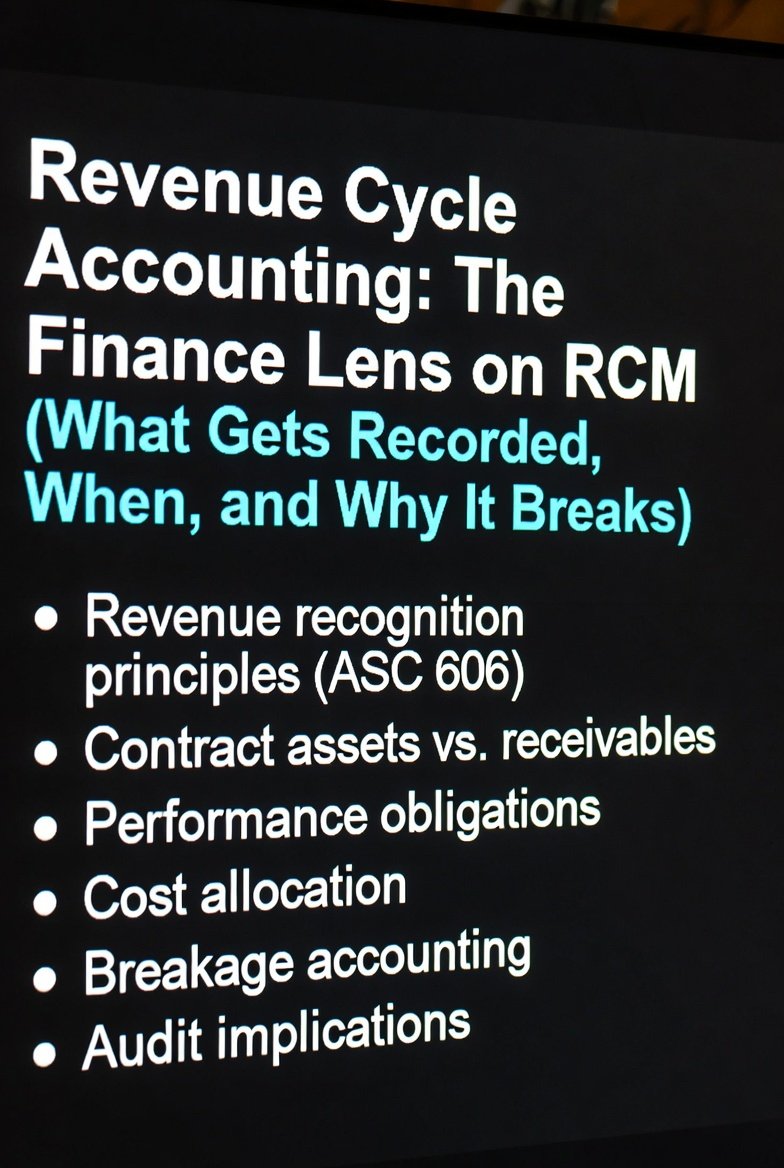
Common Accounting Mismatches (Why Finance and Ops Disagree)
Accounts receive able in medical billing
- Adjustment buckets mix contractuals and underpayments
- Posting delays temporarily inflate A/R
- Ops counts denials by claim; finance tracks dollar risk
- Charge lag masks leakage while volume looks stable
- Patient balances resolve slower than payer balances
Executive line: dashboard conflict is usually classification or timing—not mystery.
Finance KPIs That Prove RCM Is Working
- A/R aging distribution
- Denial rate by reason
- First-pass / clean claim performance
- Adjustment variance by payer
- Cost-to-collect trend
- Cash forecast vs actual variance
Each KPI answers whether defects are shrinking—or compounding.
Month-End Close Checklist (RCM ↔ Accounting)
- Top payer reconciliation: paid vs expected variance flagged
- Adjustment code hygiene reviewed
- 90-day A/R movement explained
- Top denial reasons mapped to upstream owner
- Posting backlog checked
- Charge lag sampled
- Patient balance trends reviewed
This is how month-end stops becoming an argument.
Operator Mini-Case
Mistake: posting relied on broad adjustment codes with limited reconciliation.
Consequence: underpayments blended into “normal” adjustments; cash missed forecast.
Fix: payer-specific reconciliation checklist with variance flags and weekly review.
Outcome cue: reconciliation exceptions dropped within a month; fewer unexplained shortfalls (results vary).
Point of No Return (Accounting Version)
If the same preventable failure reason appears twice, stop reworking it and fix upstream.
In finance terms: repeated rework turns cash drag into write-off probability.
In-House vs Outsource vs Software (Finance Decision)
Fix in-house when discipline and ownership are the issue.
Outsource when staffing gaps create uncontrolled aging.
Software when visibility is the bottleneck—only if teams act on it.
FAQs
What is revenue cycle accounting in healthcare?
It’s the finance lens that translates RCM activity into net revenue, A/R, cash, adjustments, and loss classifications.
How is it different from RCM?
RCM runs the workflow; accounting records and reconciles the financial impact.
Why do charges look high but cash looks low?
Because charges aren’t net collectible revenue—contractuals, denials, underpayments, and timing reduce cash.
What’s a fast signal that RCM is breaking?
Rising A/R aging plus repeat denial reasons or unexplained adjustment variance.